
Top 10 Coffee Machine Robot Suppliers for Global Buyers
Choosing a reliable coffee automation partner requires more than comparing product photos and advertised output. This guide examines the Top 10 Coffee Machine Robot Suppliers for Global Buyers through practical purchasing criteria. These criteria include brewing consistency, robotic movement, ingredient handling, cleaning access, safety controls, and after-sales support. A machine may look impressive in a showroom. Real performance appears during a busy morning rush.
Each supplier is considered from an operational and technical perspective. We review drink capacity, temperature stability, user interface design, remote diagnostics, spare-parts availability, and integration with payment systems. Food-contact materials and documented safety compliance also deserve close attention. Requirements can differ between regions, so buyers should verify certifications with local authorities and qualified professionals. The term Coffee Machine Robot covers several solutions, from robotic baristas to automated coffee stations with limited arm movement.
A careful buyer should request live demonstrations, service response times, warranty conditions, and references from comparable sites. Ask how the system performs after thousands of drink cycles. Small details matter, such as milk-line cleaning, cup alignment, and recovery after an ingredient shortage. No ranking can remove every uncertainty. Supplier data may also be incomplete or presented from a marketing viewpoint. That is worth remembering. This introduction aims to provide a balanced starting point, helping hotels, offices, retailers, and transport hubs compare suppliers with clearer expectations and fewer costly surprises.
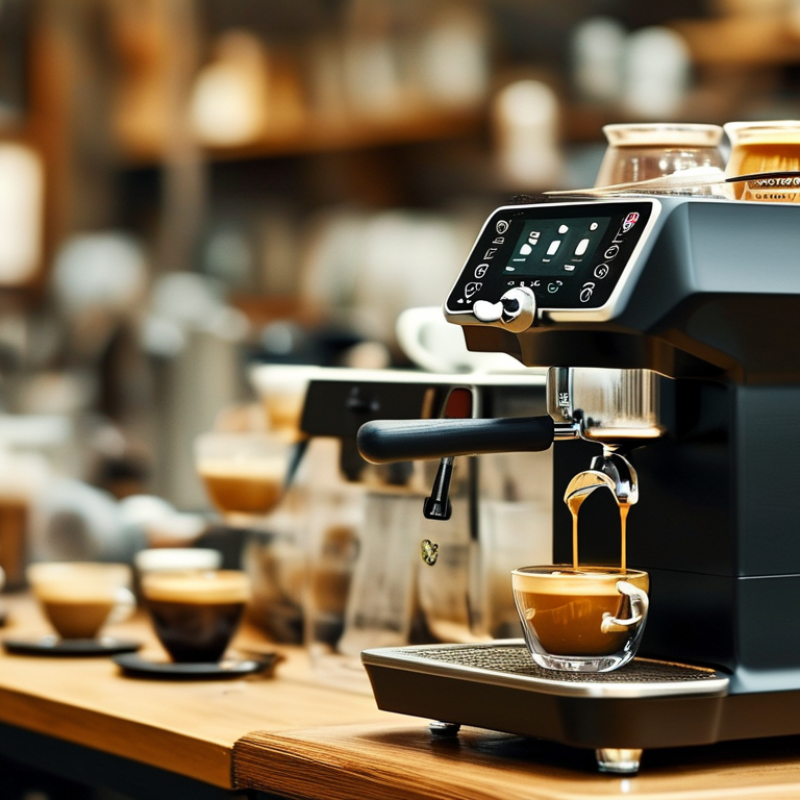
Coffee Robot Market Scope: 541,302 Industrial Robots Installed in 2023
The coffee robot market is developing alongside a much larger automation industry. In 2023, 541,302 industrial robots were installed worldwide, showing how quickly factories are adopting programmable equipment. This figure does not represent coffee machines alone. It reflects the broader technical foundation behind automated brewing, dispensing, cleaning, and payment systems.
For global buyers comparing the top 10 coffee machine robot suppliers, this distinction matters. A supplier may offer a compact robotic arm, a complete beverage station, or only the control software. Buyers should check payload, movement accuracy, cleaning cycles, power requirements, and local service coverage. A robot that handles cups smoothly in a showroom may struggle during a busy morning shift. Real testing matters.
Small details reveal practical quality. Watch how the system grips a wet cup. Check whether milk lines can be removed without special tools. Ask for maintenance records, response times, and installation references from similar sites. The 541,302 installation figure gives useful market context, but it can also create false confidence. Industrial scale does not guarantee café performance. Some suppliers still underestimate operator training, noise, and inconsistent ingredient flow. Buyers should leave room for trial periods and honest revisions before selecting equipment for multiple locations.
Top 10 Coffee Machine Robot Suppliers for Global Buyers
Coffee Robot Market Scope: 541,302 Industrial Robots Installed in 2023
| Rank | Anonymous Supplier Profile | Primary Coffee Automation | Robot Architecture | Typical Payload | Typical Reach | Indicative Throughput | Common Integration Functions | Food-Production Requirements | Buyer Suitability |
|---|---|---|---|---|---|---|---|---|---|
| 01 | Supplier Profile 01 | Capsule and pod handling | High-speed delta robot | 0.5–3 kg | 600–1,600 mm | 60–150 picks/minute | Pick-and-place, orientation, tray loading, conveyor tracking | Stainless-steel contact tooling; hygienic washdown design; food-grade polymer components | High-volume capsule and pod production lines |
| 02 | Supplier Profile 02 | Coffee-machine assembly | Six-axis articulated robot | 3–10 kg | 800–1,500 mm | 8–25 assemblies/minute | Screwdriving, component insertion, adhesive dispensing, inspection | Traceable tooling; controlled lubrication; ISO 9001-based quality systems | OEM assembly and contract manufacturing plants |
| 03 | Supplier Profile 03 | Cartoning and case packing | Four-axis SCARA or delta robot | 2–8 kg | 400–1,000 mm | 20–60 cases/minute | Carton loading, case packing, indexing, barcode verification | Washable guarding; stainless-steel end effectors; HACCP-compatible line layout | Retail packaging and export-oriented operations |
| 04 | Supplier Profile 04 | Palletizing and depalletizing | Four-axis palletizing robot | 80–180 kg | 2,000–3,200 mm | 8–20 cases/minute | Layer forming, slip-sheet handling, pallet exchange, stretch-wrap integration | Dust-resistant enclosure; safety-rated fencing; hygienic conveyor interfaces | Large beverage, appliance, and distribution facilities |
| 05 | Supplier Profile 05 | Coffee roasting and bag handling | Collaborative robot or six-axis robot | 5–20 kg | 900–1,700 mm | 6–18 bags/minute | Bag opening, filling support, weighing, sealing, reject handling | Dust-managed enclosure; food-grade grippers; cleanability-focused design | Small and medium specialty-coffee facilities |
| 06 | Supplier Profile 06 | Grinding and dosing support | SCARA or compact six-axis robot | 1–7 kg | 450–1,200 mm | 15–45 operations/minute | Hopper loading, container transfer, dosing-station replenishment, sampling | Dust extraction; sealed bearings where required; removable food-contact tooling | Automated grinding, dosing, and filling cells |
| 07 | Supplier Profile 07 | Quality inspection | Vision-guided delta or collaborative robot | 0.5–5 kg | 500–1,300 mm | 30–100 inspections/minute | Camera inspection, seal verification, label checking, dimensional measurement | LED-controlled inspection area; calibrated vision equipment; data traceability | Plants requiring consistent defect detection and process records |
| 08 | Supplier Profile 08 | End-of-line machine handling | Collaborative robot | 3–16 kg | 800–1,900 mm | 5–15 cycles/minute | Machine tending, loading, unloading, bin picking, product changeover | Risk assessment under ISO 10218 and ISO/TS 15066 principles | Flexible production lines with frequent SKU changes |
| 09 | Supplier Profile 09 | Service-robot coffee preparation | Mobile manipulator or compact collaborative robot | 1–10 kg | 600–1,400 mm | 20–80 drinks/hour | Cup placement, ingredient dispensing, brewing-cycle control, payment-system interface | Food-contact materials; sanitation procedures; emergency-stop and access controls | Retail, hospitality, airports, campuses, and unattended kiosks |
| 10 | Supplier Profile 10 | Integrated turnkey cells | Hybrid robot cell with PLC and vision | 1–180 kg | 400–3,200 mm | Application-dependent | Material handling, assembly, packaging, inspection, MES and warehouse integration | CE-oriented safety design; HACCP documentation; validated cleaning procedures | Global buyers seeking one-system integration and commissioning support |
Related Posts
-
China Best Coffee Robot Barista Supplier for Global Buyers?
-
How Robot Arm Coffee Makers Are Revolutionizing the Barista Experience with Precision and Speed
-
2026 How to Use a Coffee Robot Arm for Perfect Brews?
-
Revolutionizing the Coffee Experience at the 2025 Canton Fair with Automatic Coffee Shop Innovation
-

Explore the Future of Coffee: Discover Robot Baristas for Sale at the 138th Canton Fair 2025
-
Exploring Innovative Solutions Beyond Traditional Coffee Shops with Robotic Cafe Technology