Why Choose a Coffee Robot Arm for Your Business?

Coffee businesses are under pressure to serve faster, maintain consistency, and control labor costs. The demand is real. The National Coffee Association’s Spring 2024 National Coffee Data Trends report found that 67% of American adults drank coffee during the past day. Each order may involve grinding, dosing, tamping, brewing, steaming, and cleaning. Small delays quickly become visible during a morning rush.

A Coffee Robot Arm can automate repeatable movements while trained staff manage quality and customer interaction. The International Federation of Robotics reported 541,302 industrial robots were installed worldwide in 2023. More than 4.28 million industrial robots were operating globally. These figures show broader confidence in robotic automation, but coffee service has different requirements. Heat, moisture, changing cup sizes, and customer expectations demand careful integration. A robot is not a magic solution.

It needs a reliable workflow.

In a well-designed café, the arm can lift cups, position portafilters, move finished drinks, or support precise preparation. Its value depends on uptime, cleaning access, software controls, and staff training. The Specialty Coffee Association’s Coffee Skills Program emphasizes repeatable technique, sensory evaluation, and process control. Automation can strengthen these areas, but it cannot replace good beans, fresh water, or thoughtful recipes. That limitation matters. Businesses should measure queue time, drink accuracy, maintenance hours, and customer satisfaction before investing. A pilot project may reveal uncomfortable weaknesses in the existing layout. That is useful. Choosing a Coffee Robot Arm should therefore be a practical operations decision, supported by verified data, realistic testing, and a clear return-on-investment model.
Why Choose a Coffee Robot Arm for Your Business?

Define Coffee Robot Arms and Their Role in Automated Beverage Service

Why Choose a Coffee Robot Arm for Your Business?

Define Coffee Robot Arms and Their Role in Automated Beverage Service

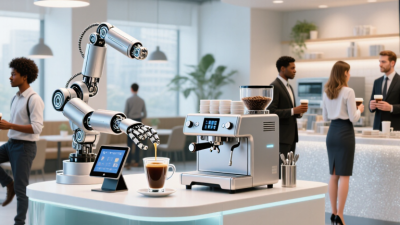
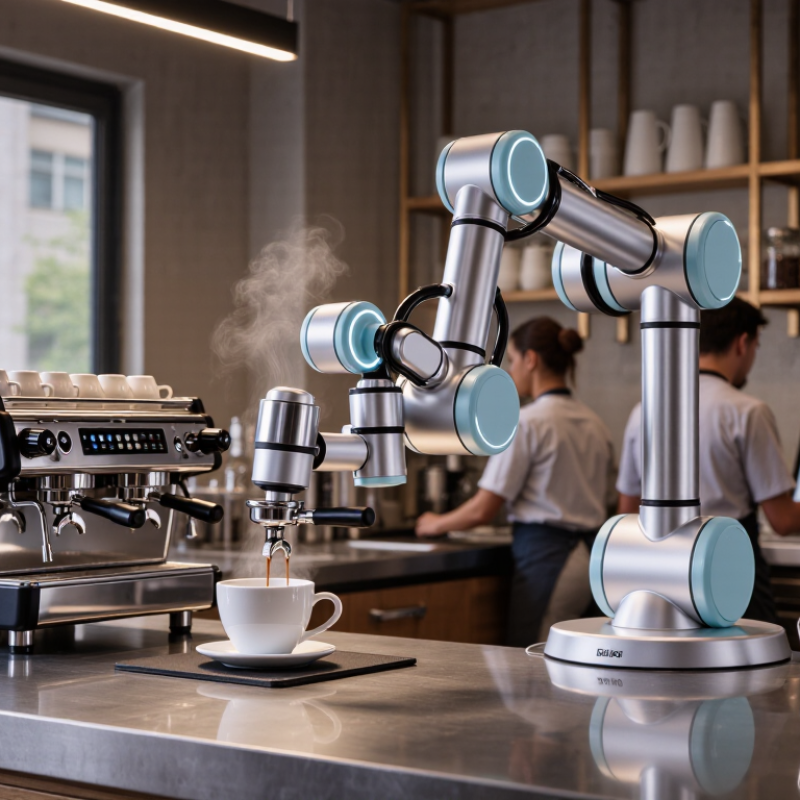
A coffee robot arm is a programmable mechanical system that moves cups, tools, or ingredients through defined drink-making steps. Many models use sensors, cameras, and collaborative motion limits. The arm may dose coffee, position a cup, pour milk, and transfer the finished drink. It does not “understand” coffee like a trained barista. It follows data, recipes, and programmed boundaries.

Its value is consistency during repetitive service. It can repeat a measured pour at a busy counter, while staff handle customer questions and quality checks. The International Federation of Robotics reported 4.28 million industrial robots operating worldwide in 2023. That figure does not measure coffee arms directly, but it shows automation is no longer experimental. The National Restaurant Association’s 2024 State of the Restaurant Industry Report identified recruiting and retaining employees as a significant challenge for 45% of operators. A robot arm can reduce some repetitive work, not solve staffing alone.

In practice, placement matters. A compact arm needs clear reach, washable surfaces, reliable ingredient feeding, and safe human access. Operators should measure drink time, cleaning time, error rates, and customer acceptance before scaling. Poor calibration can create slow pours or awkward queues. That is easy to miss. Human oversight remains essential for allergen controls, equipment faults, and unusual orders. The technology is promising, but a cheaper manual station may still win in a low-volume shop.

Market Evidence: 541,000+ Industrial Robots Installed in 2023 (IFR)

Why Choose a Coffee Robot Arm for Your Business?

The International Federation of Robotics reported more than 541,000 industrial robots installed worldwide in 2023. This figure signals a mature automation market, not a passing trend. For coffee businesses, a robotic arm can support repeatable preparation, steady portioning, and cleaner workflow during busy periods.

Picture a morning rush. Cups move along a defined station, while the arm handles repetitive movements with consistent timing. Staff can focus on customer questions, payment issues, and drink customization. A well-designed system may also reduce unnecessary lifting and wrist strain. However, industrial installation numbers do not guarantee success in a café.

The details matter. Coffee equipment must be easy to wash, inspect, and maintain. Sensors need reliable calibration. Operators require practical training, not just a short demonstration. Local food-safety rules and workplace requirements must guide the final design. A qualified automation team should test the arm with real cups, spills, queues, and cleaning routines.

Small mistakes become visible quickly.

A robotic arm may move accurately but still create an awkward customer experience. It can also require more maintenance than expected if the environment is humid or poorly organized. Businesses should measure service time, downtime, labor needs, and customer acceptance before scaling. The 541,000-plus installations provide strong market evidence, yet each coffee operation still needs its own careful assessment.

Global annual installations of industrial robots reached 541,302 units in 2023, demonstrating the scale and continued importance of automation across manufacturing. This market momentum supports the growing use of robotic arms in service applications such as coffee preparation.

Source: International Federation of Robotics (IFR), World Robotics reports.

Assess Benefits Against 177 Million Bags of Global Coffee Demand (ICO)

Why Choose a Coffee Robot Arm for Your Business?

The International Coffee Organization reported global coffee consumption at about 177 million 60-kilogram bags in 2022/23. That scale creates pressure on roasting, packing, and service operations. A coffee robot arm can support repetitive tasks, including bean loading, carton handling, and precise drink preparation. It does not replace every worker. It reduces physical repetition during long shifts.

The International Federation of Robotics recorded 541,302 industrial robot installations worldwide in 2023. This figure shows broader industrial confidence in automation, but coffee businesses need practical evidence. A robot arm can repeat movements consistently, maintain measured portions, and operate during demand peaks. Staff can then focus on quality checks, customer interaction, and machine sanitation. The best results usually come from small, measurable deployments.

However, automation is not magic. A poorly positioned arm creates expensive theater. Operators still need training, guarding, cleaning routines, and emergency procedures. Installation may also disrupt a compact café or roasting floor. Before purchasing, measure hourly orders, task duration, error rates, and labor bottlenecks. Compare those figures with the robot’s cycle time and maintenance requirements. The 177-million-bag market signals opportunity, not guaranteed profit. A careful pilot may reveal that one repetitive task deserves automation, while another still needs human judgment.

Why Choose a Coffee Robot Arm for Your Business? — Assess Benefits Against 177 Million Bags of Global Coffee Demand (ICO)
Assessment Dimension Reference Data Business Meaning Robot-Arm Relevance
Global coffee consumption Approximately 177.0 million 60-kilogram bags in coffee year 2022/23. The global market is large enough for improvements in speed, consistency, and labor utilization to have meaningful commercial value. Supports automation investment where beverage volume is high and repetitive tasks are frequent.
Equivalent green coffee volume 10.62 billion kilograms, calculated as 177.0 million bags × 60 kilograms. Large aggregate volume indicates sustained demand across roasting, dispensing, preparation, and service operations. A robot arm can be evaluated for repetitive handling, dosing, tamping, cup movement, or machine-loading tasks.
Illustrative beverage equivalent Approximately 1.062 trillion 10-gram servings, calculated from 10.62 billion kilograms ÷ 0.01 kilogram. Even a small improvement in repeatability or waste control can become significant when multiplied across high transaction volumes. Automation is most valuable when the same motion or recipe is repeated many times per day.
Consistency of preparation Robot performance is application-specific; accuracy, repeatability, and cycle time must be validated during an on-site pilot. Consistent dosing, positioning, and sequencing can reduce variation between operators and shifts. Strong benefit for standardized menus, centralized production, and high-volume service points.
Labor utilization No universal labor-saving percentage applies; results depend on workflow design, staffing, opening hours, and local wage rates. The main opportunity is to shift staff time from repetitive movements to customer service, quality checks, replenishment, and exception handling. Potentially attractive when the arm can operate during predictable peaks without reducing service quality.
Throughput and peak demand Required throughput should be calculated from actual orders per hour, recipe cycle time, queue tolerance, and equipment capacity. A faster individual motion does not automatically increase total output if grinding, extraction, cleaning, or payment remains the bottleneck. Best assessed as part of an integrated cell rather than as a standalone device.
Ergonomics and repetitive work Manual handling risk varies by reach distance, force, repetition rate, posture, and object weight; a workplace assessment is required. Automation may reduce exposure to repeated lifting, reaching, wrist rotation, and high-frequency tool movements. Relevant where staff repeatedly perform the same physically demanding task throughout a shift.
Food and operator safety Industrial robot safety is addressed by ISO 10218; collaborative applications may also require ISO/TS 15066. Food-contact components must meet applicable local regulations. Safety, sanitation, guarding, emergency stops, cleaning access, and allergen control must be designed into the complete system. A robot is suitable only after risk assessment, hygienic design review, and validation of the intended operating mode.
Waste and portion control Actual savings must be measured from baseline ingredient usage, rejected drinks, spills, purge cycles, and calibration losses. More controlled movements and repeatable portions can support waste reduction, but cleaning and changeover losses must also be included. Potential benefit is highest in standardized recipes with measurable ingredient inputs and outputs.
Scalability A scalable system requires documented recipes, repeatable interfaces, maintenance procedures, staff training, and performance records. Standardized automation can make processes easier to reproduce across multiple locations or production lines. Most useful when the business has stable workflows and enough volume to justify integration and support costs.
Investment decision test Compare total ownership cost with measurable benefits: labor hours redeployed, additional orders served, waste avoided, downtime, maintenance, training, and integration. A positive business case depends on utilization and workflow fit, not on global demand alone. Proceed only if a pilot confirms safety, quality, throughput, uptime, cleaning time, and payback assumptions.
Sources and calculation notes: International Coffee Organization (ICO), coffee year 2022/23 global consumption of approximately 177.0 million 60-kilogram bags; 60 kilograms per bag and the 10-gram serving equivalent are used for transparent calculations. Robot performance, labor impact, waste reduction, and return on investment are site-specific and should be verified through a controlled pilot. Safety references: ISO 10218 and ISO/TS 15066.

Apply Safety Standards: ISO 10218 and ISO/TS 15066

Why Choose a Coffee Robot Arm for Your Business?

Apply Safety Standards: ISO 10218 and ISO/TS 15066

A coffee robot arm works near staff, customers, hot liquids, glassware, and sharp machine edges. Safety cannot depend on a supplier’s brochure. The ISO 10218 series addresses robot and system integration safety, including safeguarding, stopping, validation, and responsibilities. ISO/TS 15066 adds guidance for collaborative applications, including contact forces, speeds, and protective separation. Neither document makes an installation automatically safe. That distinction matters.

The International Federation of Robotics reported 541,302 industrial robot installations worldwide in 2023. Its World Robotics 2024 report also recorded more than 4.28 million operating units. This growth shows adoption, not proof of safe deployment. A café risk assessment should map cup pickup, syrup dosing, steam wand use, cleaning, and maintenance. It must consider pinch points, unexpected restarts, slippery floors, heat, and customer reach. Use barriers or scanners where collaboration cannot be controlled reliably.

During commissioning, an experienced integrator should document emergency stops, protective devices, software limits, stopping distances, and contact-risk measurements. Staff need repeated training, not one rushed demonstration. ISO/TS 15066 supports measured force and pressure limits, but real cafés change during queues and spills. That is the imperfect part. Recheck the assessment after layout changes, new cup designs, or faster service recipes. Safety records should identify test dates, equipment conditions, and unresolved findings.

Calculate ROI Through Utilization, Labor Savings, and Payback Periods

Why Choose a Coffee Robot Arm for Your Business?

A coffee robot arm should be evaluated through utilization, labor savings, and payback period. The U.S. Bureau of Labor Statistics reported median hourly pay near $14 for food preparation and serving-related occupations in its May 2023 data. However, wages are only one input. Scheduling gaps, training time, repetitive strain, and service speed also affect operating costs. The National Restaurant Association’s 2024 industry report highlighted persistent hiring and labor-cost pressure for foodservice operators.

Utilization matters most.

Consider a $60,000 installation delivering 1,620 labor-equivalent hours annually. At $14 per hour, gross labor savings reach $22,680. After assuming $5,000 for maintenance, software, cleaning, and supervision, annual savings fall to $17,680. The estimated payback is about 3.4 years. A busier site could achieve faster recovery. A slower site may not.

Test the assumption carefully. That number may be optimistic. The International Federation of Robotics reported more than four million industrial robots operating worldwide in 2023, but coffee service has different demands. Measure drinks per hour, active operating hours, failed orders, cleaning intervals, and staff intervention. A simple model is: annual benefit equals labor savings plus verified extra sales, minus maintenance and energy costs. Exclude unproven revenue at first. A spreadsheet can flatter reality. Real shift data is better.